Keywords:Panasonic A6 Servo Installation Instruction, Panasonic A6 Driver, Panasonic A6 Series Servo Motor Manual
Panasonic A6 Motor & Driver Instruction 3.4 Inputs and outputs on connector X4 — Interface Circuit (Input)
Abstract
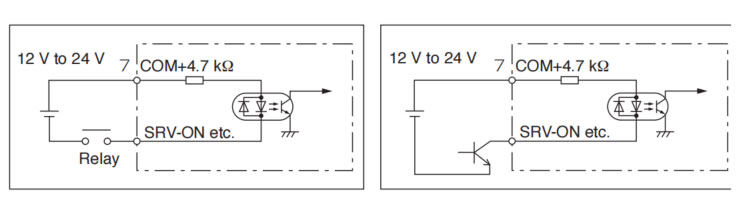
Here in this chapter is the wiring instruction of input/out connecting to the contacts of switches and relays, or open collector output transistors.
Input Circuit
Connect to contacts of switches and relays, or open collector output transistors.
When you use contact inputs, use the switches and relays for micro current to avoid contact failure.
Make the lower limit voltage of the power supply (12V to 24V) as 11.4V or more in order to secure the primary current for photocouplers.
10 sysems: SI1 to SI10. For assign and function, refer to P.3-40 to P.3-45.
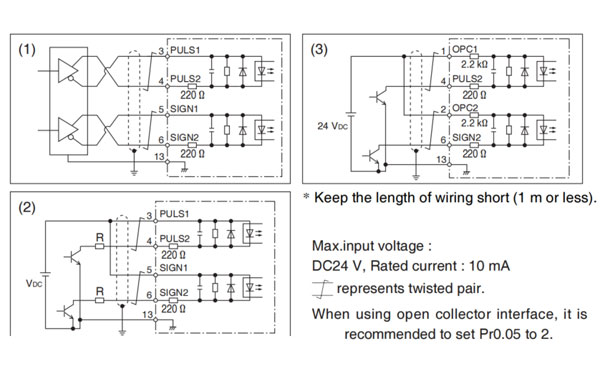
Line driver I/F (Permissible max, input frequency of command pulse input signal.: 500 kpulse/s)
This signal transmission method has better noise immunity. We recommend this to secure the signal transmission.
Open collector I/F (Permissible max. inout frequency of command pulse input signal.: 200 kpulse/s)
The method which uses an external control signal power supply (VDC)
VDC
Specifications
12V
820 Ω 1/2W
24V
2 kΩ 1/2W
(VDC - 1.5)/(R+220) = 10mA
Current regulating resistor (R) corresponding to VDC is required in this case.
Connect the specified resister as below.
(R) should be placed close to the driver for effective noise reduction.
Open collector I/F (Permissible max. input frequency of command pulse input signal.: 200 kpulse/s)
Connecting diagram when a current regulating resistor is not used with 24V power supply.
1 system: Pl1. For function, refer to P.3-38, P.3-39.
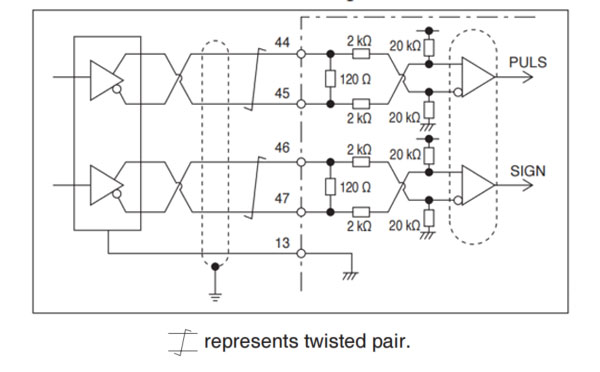
Line driver I/F (Permissible max. input frequency of command pulse input signal.: 8 Mpulse/s)
This signal transmission method has better noise immunity. We recommend this to secure the signal transmission when line driver I/F is used.
1 system: P12. For function, refer to P.3-38, P.3-39.
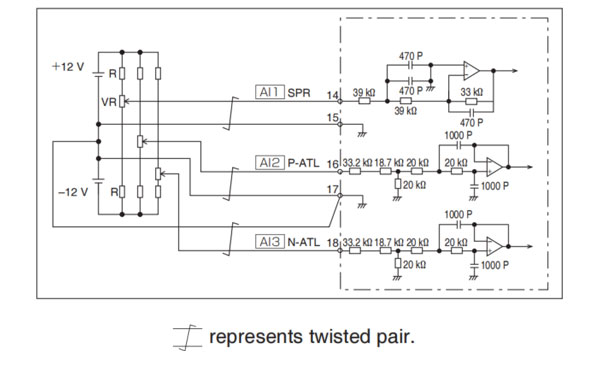
It goes through 3 systems, AI1 to AI3.
Max. permissible input voltage to each input is ±V. For input impedance of each input, refer to the right Fig.
When you compose a simple command circuit using variable resistor (VR) and register R, connect as the right Fig. shows. When the variable range of each input iss made as -10V to + 10V, use VR with 2 kΩ, B-characteristics, 1/2 W or larger, R with 200 Ω, 1/2 W or larger.
A/D converter resolution of each command input is as follows. (1) ADC1: 16-bit (AI1) (2) ADC2: 12-bit (AI2, AI3)
For function, refer to P.3-46, P.3-47.
Only for the standard type and communication type are not provided with analog input.
Best Buy Robotic Arm for Injection Molding Machine
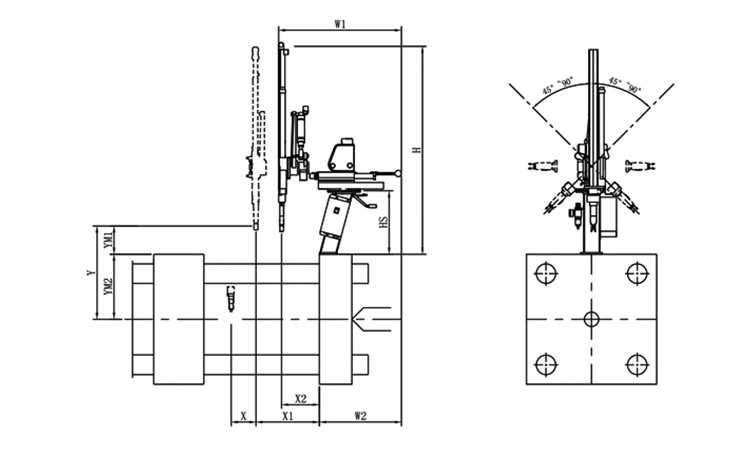
SW255C
Unit: mm
X1
X2
X3
X4
Y
YM1
YM2
Z
L
W
H
Payload
300
100
0
0
550
155
395
-45°~+45°
650
650
1260
2kg
The Application of End of Robotic Arm Tooling
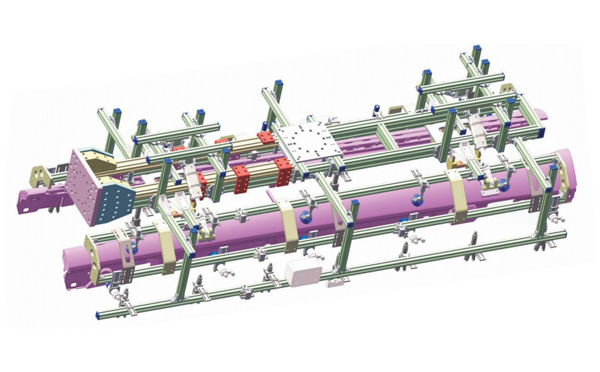
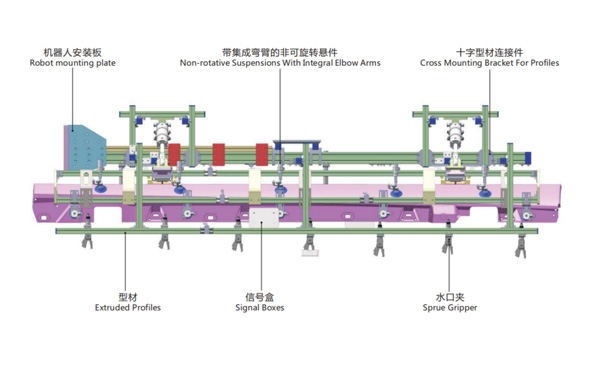
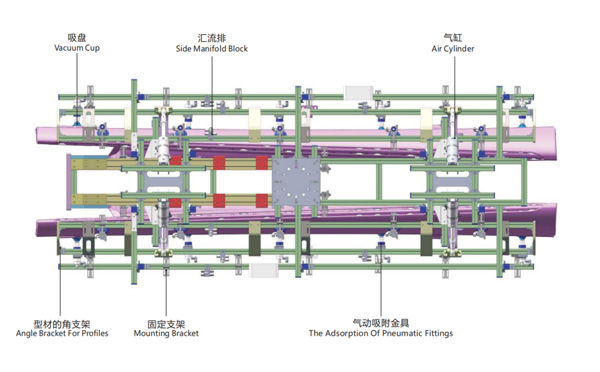
EOAT Assembly Demonstration -- One Cavity Car Threshold Strip Picking EOAT
One Cavity Car Threshold Strip Picking EOAT
Product Descriptions
This EOAT is for One Cavity Car Threshold Strip Picking;
EOAT Function: Car Threshold Strip Picking and Runner Cutting;
Injection Molding Machine Clamping Force: 2700T;
Number of Runner: 14
The Gross Weight of the EOAT Seet is about 80kg.
Q & A About Robotic Arms and Injection Automation
What Would be The Expectable Cycle Time In Production of 120ml Temper Evidence Cups With All Machineries Made In China?
With the advancement of technology, the injection machineries and automation solutions made in China are doing a much better job in thin-wall IML containers production. As for the production 120ml temper evidence cups for Yogurts, the best cycle time in a trial IML production of 6 cavities application with SWITEK SW8 Series IML robot and YIZUMI P380K3 high speed injection molding machine, the cycle time had been reduced to around 5.5s. Take the overall investment into consideration, it's an amazing bargin for the thin-wall IML containers producers in any world.